If you think back to someone who shaped how you grew up, you probably don't remember their exact words first. You remember something about how it felt to be around them. There was a steadiness, or a way they paid attention, that made hard things feel a little more manageable.
Decades of research across developmental psychology, neuroscience, attachment theory, and education keep arriving at a version of this same idea: the quality of a relationship changes what becomes possible within it. Connection doesn't replace boundaries or accountability. It creates the conditions that make learning, problem solving, and growth more likely.
Here's some of what the research says about why, and what it can look like in practice.
What the research tells us
This idea shows up across developmental psychology, neuroscience, education, and attachment theory. A few of the key findings:
Children and adolescents learn more effectively from people they trust. Research on student-teacher relationships consistently finds that when students perceive their teacher as caring and supportive, they show greater academic engagement, stronger motivation, and fewer behavioral difficulties.
Relational trust also appears to affect how willing a student is to take intellectual risks, ask questions, and persist through difficulty. A student who feels judged or unseen is less likely to raise their hand, and that reluctance has academic consequences over time.
Curiosity requires a baseline of safety. When people feel emotionally secure, they're more willing to sit with confusion and explore unfamiliar ideas. Developmental research suggests this pattern begins in infancy and continues through adulthood.
Attachment theory describes this as the "secure base" effect. A child who feels connected to a trusted adult is more willing to venture out, try new things, and return when they need support. The same dynamic shows up in classrooms. Students who feel emotionally safe are more likely to engage with challenging material rather than shutting down or acting out.
When the nervous system detects threat, the brain shifts resources. Areas involved in survival responses become more active, while the prefrontal cortex, the part responsible for reasoning, language processing, executive functioning, and flexible thinking, becomes less accessible.
A stressed child may still take in information, but the kinds of thinking we most often ask of them, like problem solving, perspective-taking, and planning ahead, become harder to access. The brain is prioritizing safety over reflection.
This is why a child in the middle of a meltdown rarely responds to logical explanations. The parts of the brain needed to process that reasoning are, temporarily, less available.
Self-regulation develops over time, and it develops through relationships. Research in developmental neuroscience suggests that children first learn to manage their emotions and behavior through co-regulation, the process of being calmed by a calm adult.
A caregiver who stays steady during a child's distress is doing something neurobiologically significant. They are offering their own regulated nervous system as a kind of external scaffold. Over many repeated experiences, the child begins to internalize those patterns and develop their own capacity for regulation.
Expecting a child to "calm down on their own" before they've had enough co-regulation experience is a bit like asking someone to ride a bike before they've had training wheels. The skill builds through supported practice, not through being left to figure it out alone.
One of the most consistent findings in resilience research is the importance of at least one stable, committed relationship with a supportive adult. The Harvard Center on the Developing Child has identified this as the single most common factor among children who develop well despite serious adversity.
The relationship doesn't need to be perfect. What matters is that it's dependable. A child who knows that someone will show up, listen, and stay consistent, even after hard moments, builds a different internal narrative about the world and their place in it.
Research consistently shows that children feel safest when they have both warm relationships and clear, predictable expectations. Boundaries communicated with respect give children a sense of containment. They know what to expect, and that predictability reduces anxiety.
How a boundary is delivered matters as much as the boundary itself. Limits held with empathy and explanation tend to support cooperation and internalized motivation. When limits come through fear or shame, they're more likely to increase stress and resistance over time.
Connection and accountability work together
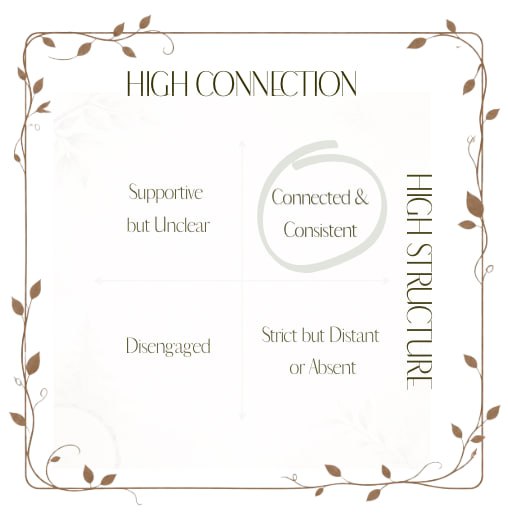
Decades of research on parenting styles and classroom climate consistently support the same conclusion: children do best with a balance of warmth and structure rather than either one alone.
A child who feels loved but doesn't know what's expected of them can carry a different kind of stress. The ambiguity itself becomes unsettling. And rules enforced through fear or distance may produce compliance in the short term, but they tend to erode trust over time. Children do best when they have both.
Researchers sometimes describe this using the terms authoritarian and authoritative, which sound similar but describe very different approaches. An authoritarian style relies on control: strict rules, little flexibility, and obedience as the primary goal. The message is often "because I said so." An authoritative style also has clear expectations, but those expectations are held within a relationship. There's room for explanation, for listening, for adjusting when something isn't working.
The difference shows up in outcomes. Children raised with authoritative approaches, high warmth and high structure together, tend to show stronger self-regulation, better social skills, and greater academic engagement than children raised with strict control alone. The structure still matters. But the relationship is what makes it land.
What this looks like
The difference between correction first and connection first is often subtle. The expectation stays the same. What changes is the entry point.
"You need to pick your head up and get started. Everyone else is working."
"Hey. I noticed you're not starting. What's going on?" A pause. Then: "Let's figure out a way in together."
"I know that's not true. You're in trouble for lying."
"I think we both know what happened. I'm not upset about the mistake. I want you to feel safe enough to tell me the truth."
"You're not doing anything else until this is cleaned up."
"I know it's hard to stop when you're in the middle of something. I'll help you get started. We clean up together."
In every case the expectation stays. The assignment still needs to happen. The lie still gets addressed. The mess still gets cleaned up. What changes is the entry point, and whether the child's nervous system is met with threat or with safety first.
Who helped you feel safe enough to grow?